
 Español
 العربية

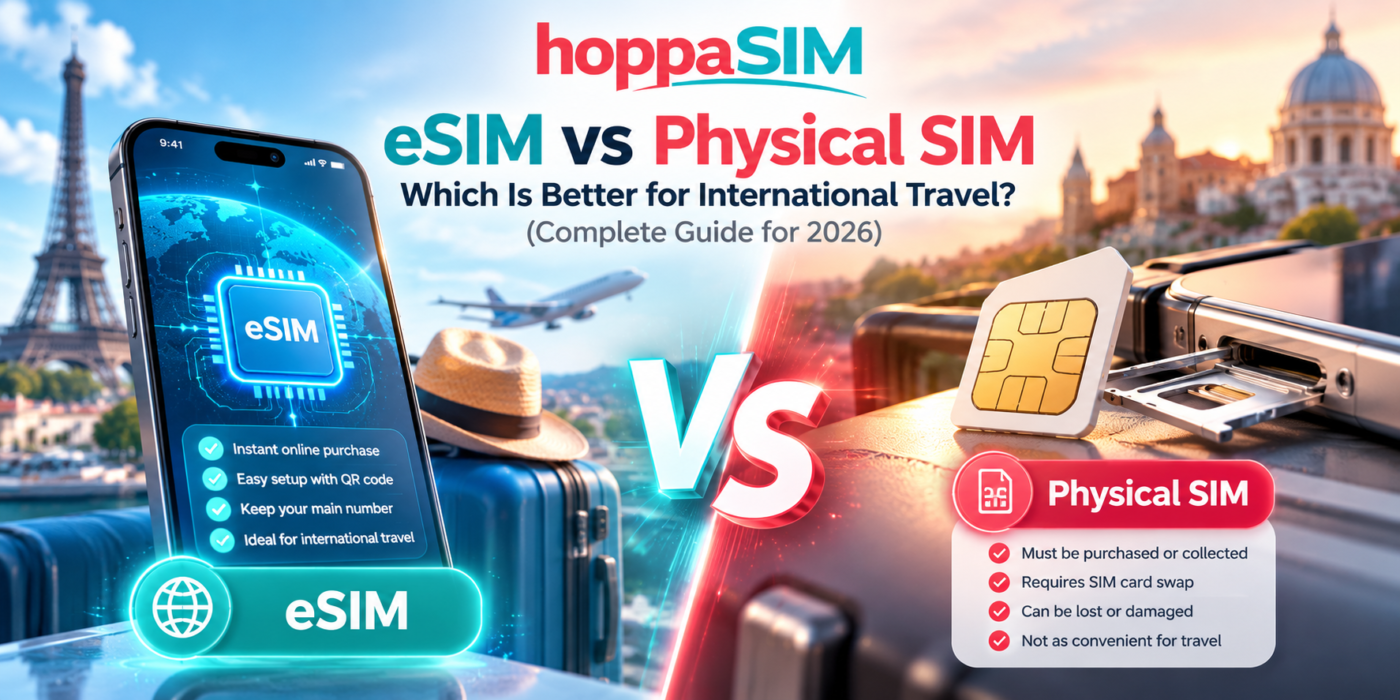
eSIM vs Physical SIM: Which Is Better for International Travel?
Both eSIMs and traditional physical SIM cards can connect your phone to a mobile network, but they work very differently when it comes to travelling. This guide compares setup, convenience, cost, security, Dual SIM use, coverage and flexibility so you can understand which option makes more sense for your next trip.
For many international travellers, eSIM is the more convenient option because it can usually be purchased online, delivered digitally and installed without removing your existing SIM card. A physical SIM can still be useful if your phone does not support eSIM or if you specifically need a local physical SIM service.
eSIM
A digital SIM profile downloaded directly to a compatible phone. No removable card is required for that mobile plan.
Physical SIM
A removable plastic SIM card that is inserted into your phone’s SIM tray.
What Is the Difference Between eSIM and a Physical SIM?
An eSIM and a physical SIM perform the same basic job: they allow your phone to identify your mobile subscription and connect to a mobile network.
The main difference is how that subscription is stored on your phone.
With a traditional SIM, the mobile subscription is associated with a removable card that you insert into the device.
With an eSIM, the mobile profile is downloaded digitally onto compatible eSIM technology built into the device.
eSIM vs Physical SIM: Full Comparison
| Feature | eSIM | Physical SIM |
|---|---|---|
| Format | Digital profile stored on a compatible device | Removable plastic SIM card |
| Delivery |
Digital
Often delivered electronically shortly after purchase |
Must normally be collected, purchased in person or delivered physically |
| Installation | QR code, app, link or manual activation details | Insert the SIM card into the phone |
| Changing travel plans | Install another compatible profile | Remove and replace the physical SIM |
| Risk of losing SIM | No removable card | Small SIM card can be misplaced |
| Multiple plans | Many compatible phones can store multiple profiles | Limited by physical SIM slots and cards |
| Dual SIM travel use | Often very convenient | Depends on available physical SIM slots |
| Immediate travel purchase | Usually possible | May require finding a shop or waiting for delivery |
| Older phone compatibility | Requires eSIM-compatible hardware | Supported by many older phones |
| Signal quality | Depends on network and coverage | Depends on network and coverage |
| Internet speed | Depends on network, coverage and device | Depends on network, coverage and device |
What Are the Advantages of an eSIM?
eSIM advantages
- No physical card delivery required
- Convenient for international travel
- Easy to keep your normal SIM installed
- Multiple profiles can be stored on many phones
- No SIM ejector tool required
- No travel SIM card to physically lose
eSIM limitations
- Your phone must support eSIM
- Regional phone variants can differ
- A network-locked phone may cause problems
- Transferring or reinstalling profiles may require provider assistance
- Some users may initially find digital setup unfamiliar
What Are the Advantages of a Physical SIM?
Physical SIM cards remain widely used and can still be the right choice in certain situations.
Physical SIM advantages
- Works with many older phones
- Easy to physically move between compatible unlocked phones
- Familiar setup process
- Widely available from local mobile operators
- Useful where eSIM support is unavailable
Physical SIM limitations
- Must be physically obtained
- Can be lost or damaged
- Requires opening the SIM tray
- Swapping SIMs can mean removing your normal SIM
- You may need to find a shop after arriving abroad
Which Is Easier for International Travel?
For many travellers, eSIM has a practical advantage because the entire purchase and installation process can be completed digitally.
With a travel eSIM, you can often:
- Choose a destination before leaving home
- Purchase a data package online
- Receive installation information electronically
- Install the plan before or during your trip
- Keep your regular SIM installed on a compatible phone
With a local physical SIM, you may instead need to visit a mobile operator, airport kiosk, convenience store or other retailer after reaching your destination.
Travelling with an eSIM
You purchase your plan online before departure, install it on your compatible phone and select the eSIM for mobile data when you arrive.
Your normal SIM can often remain installed for your existing number.
Travelling with a physical SIM
You may purchase a SIM after arrival, open your phone’s SIM tray and replace or add the local SIM.
If your phone only has one physical SIM slot, you may need to remove your home SIM.
Is eSIM Cheaper Than a Physical SIM?
Neither technology is automatically cheaper simply because it is an eSIM or a physical SIM.
The actual price depends on the provider, destination, data allowance, validity period and network arrangements.
A local physical SIM may sometimes have very competitive local pricing, especially for longer stays.
A travel eSIM can provide another type of value: convenience. You can compare plans online and arrange your data without spending time finding a mobile shop after arrival.
Does eSIM Have Better Signal or Faster Internet?
An eSIM is not automatically faster than a physical SIM.
Both technologies can access 4G and 5G where supported by the device, network and plan.
Real-world signal and mobile-data performance depend on factors such as:
- The mobile network your plan uses
- Local network coverage
- 4G and 5G availability
- Network congestion
- Your phone model
- Supported radio frequencies
- Your location inside or outside buildings
Which Is More Secure: eSIM or Physical SIM?
Both technologies are designed to provide secure mobile network authentication, but their physical characteristics differ.
A physical SIM can be removed from the phone.
An eSIM profile cannot be removed simply by taking a card out of the SIM tray because it is stored digitally inside the device.
However, an eSIM should not be treated as a substitute for normal phone security.
You should still protect your device and account with:
- A strong phone passcode
- Face ID, fingerprint or other biometric security
- A secure email account
- Two-factor authentication where available
- Secure handling of eSIM QR codes and activation details
Can You Use an eSIM and Physical SIM at the Same Time?
Yes, on many modern Dual-SIM smartphones.
This is one of the strongest reasons travellers choose eSIM.
A common setup is:
| Phone line | Purpose | Typical travel setting |
|---|---|---|
| Home SIM | Keep your regular number | Calls / texts where needed |
| HoppaSIM travel eSIM | Internet while travelling | Selected as Mobile Data line |
| Data Roaming | Allows travel eSIM to use partner networks | ON for the travel eSIM when required |
| Mobile Data Switching | Controls automatic switching between data lines | Often OFF for predictable travel use |
This allows you to keep your usual SIM inside your phone while using a separate data package abroad.
Is It Easier to Switch Networks With eSIM?
eSIM can make managing multiple mobile profiles easier because compatible phones can store digital profiles in their settings.
With a physical SIM, changing to another network usually means physically changing cards.
With eSIM, changing plans can often involve downloading another profile and selecting the relevant line in your phone settings.
Exact behaviour depends on your phone and provider.
What Happens If You Lose Your Phone?
A physical SIM can potentially be removed from a lost phone.
An eSIM cannot be physically removed in the same way because the mobile profile is stored inside the device.
In either case, if your phone is lost or stolen you should contact your mobile provider and use the security tools available for your device.
eSIM or Physical SIM: Which Should You Choose?
The best option depends on your phone and how you travel.
Consider eSIM if:
- Your phone supports eSIM
- You want to arrange data before travelling
- You want to keep your normal SIM installed
- You visit several countries
- You prefer digital setup
- You do not want to search for a local SIM shop
Consider a physical SIM if:
- Your phone does not support eSIM
- You specifically want a local physical SIM
- You regularly move the SIM between devices
- Your chosen network does not offer suitable eSIM service
- You prefer a traditional removable card
Why eSIM Is Particularly Useful for Travellers
eSIM does not completely replace the usefulness of a physical SIM, but international travel is one of the situations where its advantages become very clear.
Travellers can often purchase a plan remotely, install it before reaching their destination and keep their existing SIM inside the phone.
This can reduce the need to queue at airport kiosks, search for mobile shops or keep track of several tiny physical SIM cards during a trip.
Frequently Asked Questions
Is eSIM better than a physical SIM?
Does eSIM have better signal than a physical SIM?
Is eSIM faster than a physical SIM?
Can I use eSIM and physical SIM together?
Is eSIM cheaper for international travel?
Can I switch back to my physical SIM after using an eSIM?
Will using an eSIM change my WhatsApp number?
Can an eSIM be lost?
Do I need to remove my normal SIM to install an eSIM?
Is a physical SIM still useful in 2026?
eSIM vs Physical SIM: The Bottom Line
eSIM and physical SIM technology ultimately perform the same basic function: allowing your phone to connect to a mobile network.
The major difference is convenience.
A physical SIM must be inserted into your phone, while an eSIM can be downloaded digitally on a compatible device.
For international travellers, this can make eSIM especially useful. You can arrange mobile data before your trip, keep your existing SIM installed and switch between mobile profiles without carrying multiple plastic SIM cards.
If your phone supports eSIM and is unlocked, a travel eSIM is therefore worth considering before your next trip.
Want to try an eSIM on your next trip?
Check whether your phone supports eSIM, choose your destination and browse HoppaSIM travel data plans. Your eSIM is delivered digitally so you can prepare before you travel.